Death Records can be retrieved instantly through the New Mexico Department of Health’s online portal, where a certified copy arrives within days after payment of modest fees. Users enter the decedent’s name, date of death, or record number to launch a death record search, and the system returns the official death certificate PDF along with a receipt. The platform also displays processing time estimates, accepted payment types, and a secure link to download the death certificate copy.
When families or legal representatives need a death certificate request, the portal verifies eligibility by checking relationship to the decedent and required identification such as a driver’s license or government ID. The site explains which documents qualify as supporting evidence and outlines the death record fees for each request type. Privacy safeguards protect confidential medical details, while historical records older than 25 years become publicly searchable, helping genealogists trace ancestry without exposing sealed information.
How to Search Death Records
Death records in New Mexico are held by the Bureau of Vital Records and Health Statistics, a unit of the New Mexico Department of Health. A death record search begins with the decedent’s legal name plus the date and county of death, then moves into a request step where the bureau checks who may receive a copy. Records and updated dissolution of marriage are frequently consulted when verifying active county cases. Depending on the request and the age of the record, the result can be a certified death certificate with a registrar’s seal or an uncertified copy open to the public. The steps below cover where to search, what each field means, and which copy type fits an estate, an insurance claim, or family research.
Official Search Portal: https://www.nmhealth.org/about/erd/bvrhs/
Steps to Search
- Visit the New Mexico Department of Health’s Bureau of Vital Records and Health Statistics page.
- Choose the appropriate death record request or certificate order option.
- Enter the decedent’s full legal name.
- Add the date or date range of death and county, if known.
- Use the date of birth to distinguish similar names.
- Enter the death record number, if available.
- Check results against the name, death date, county, and age.
- Select the correct record and certificate type.
- Provide requester details, identification, and required documents.
- Pay the listed fee, choose delivery, and save the confirmation number.
- If no result appears, contact the bureau with the available details.
Search Fields That Carry Death Records
Each field in a death record search filters the state database, so a small error can remove the right person from the list. The fields below cause most missed results, and each one gives you a way to retry with a different spelling or a wider scope.
A useful retry pattern is to search the surname alone across a wide date range, then narrow with county and birth year. This approach works better than starting with a narrow set of dates, since a wrong date removes an otherwise perfect match.
Choosing the Right Kind of Death Record
Several kinds of records answer different questions about a death. Only the certified death certificate carries the registrar’s certification, so legal and benefit purposes call for that version. The other records work as leads, context, or proof of burial.
An obituary or cemetery record can point you to the right county and date, yet neither replaces a certified death certificate for a claim. If your task involves money, property, or court paperwork, order the certified version from the start.
Details and Causes of Death
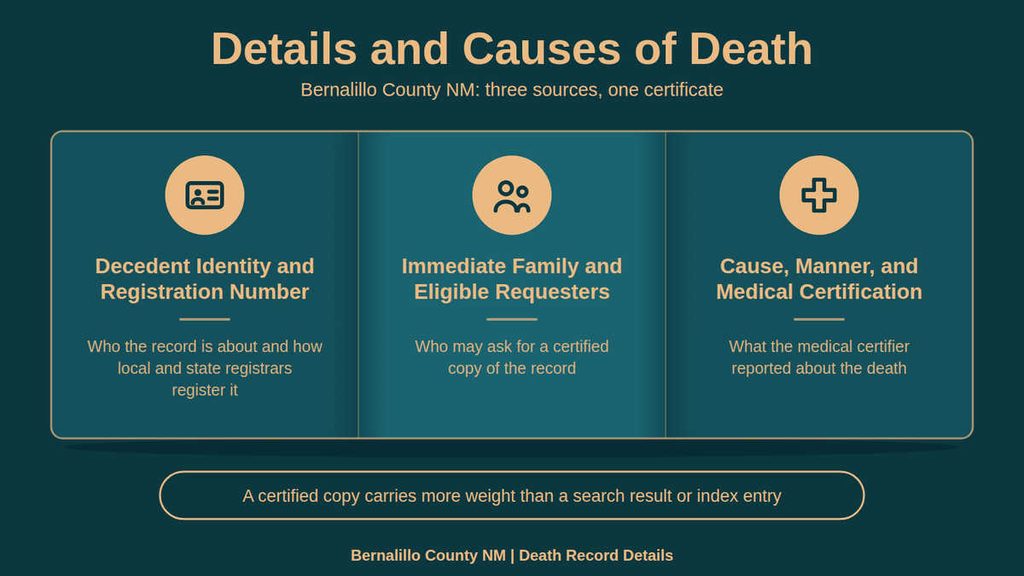
Every death record joins three sources: the medical certification of the death, the funeral home’s report of final disposition, and the registration work performed by local and state registrars. The certificate gathers the results into one document, which is why a certified copy carries more weight than a search result or an index entry. Knowing which source supplied each field helps you spot gaps before a claim or a probate filing depends on the record.
Decedent Identity and Registration Number
The identity block on a New Mexico death record holds the facts used to match one person against another. A legal name, aliases, date and place of birth, date and time of death, place of death, and usual residence form the core of that block. Parents’ names, marital status, occupation, and education appear as well, and each one can confirm that a result belongs to the person you are seeking.
Immediate Family and Eligible Requesters
New Mexico limits recent death certificates to people with a recognized stake in the death. The state’s rules list categories that cover relatives, estate representatives, and parties connected to a legal claim. The bureau reviews each request, so a relationship alone does not settle every case, and a written explanation often speeds the decision.
- Spouse, parents, children, and grandchildren of the deceased
- Executor or administrator of the deceased’s estate
- A person acting in the best interest of the deceased’s estate
- Attorneys, accountants, or agents handling matters for the estate
- People and organizations with a direct, material, and legally recognized interest in the death, such as an insurance company, funeral home, creditor, or government agency processing a claim
State the relationship plainly on the request and name the specific claim, case, or estate matter that requires the copy. When you act for someone else, attach proof of that authority, such as a letter of authorization, a court appointment, or a power of attorney. Photo identification usually accompanies the request, and the bureau may ask for more proof before issuing a certified copy.
Cause, Manner, and Medical Certification
The cause of death comes from the medical certification process, not from the registrar. A physician or other authorized health practitioner certifies most deaths, and the entries follow a standard set used across the United States. The manner of death classifies the broader category, which keeps the medical and legal meaning of each entry clear.
Official Certificates and Amendments
An official death record reaches you as a certified death certificate or an uncertified copy. A certified copy bears the registrar’s signature and seal, and agencies that handle benefits, insurance, property, and court matters accept it as proof of death. An uncertified copy serves study and family history needs, yet carries no certification, so institutions often reject it for a formal filing.
Every certified copy includes the death record number, the filing date, and the registration details that let any agency confirm it with the bureau. Keep the certificate safe, since many organizations ask for the same certified copy again rather than accept a photocopy. Some agencies also ask for a long-form copy that shows the cause of death, so order the format that matches your paperwork before paying.
Required Identification and Processing Fees
The request form calls for identification before a certified copy leaves the bureau. A government-issued photo ID, such as a driver license, state ID, or passport, is the usual starting point. The form also asks for your relationship to the decedent and for supporting documents that back up that relationship or claim.
Your total cost depends on the number of copies, the copy type, any expedited handling, and delivery. Read the fee schedule on the bureau’s page before you submit payment, and keep the confirmation page for your records. The order confirmation also shows the current processing estimate, and that estimate changes with the record type and with any medical review still open on the file.
Correcting Errors and Submitting Amendments
Errors on a death record are common because a certificate is assembled from several sources during a short period. A misspelled name, a wrong birth date, or an incomplete cause of death can appear on the first copy. New Mexico corrects these through an amendment process that compares the certificate with supporting documents and issues an amended certificate when the change is supported.
Documents That Support Most Corrections
The bureau needs a source document for most corrections, and the strongest source is the agency that holds the original fact. Gather the paperwork before submitting the request, since a missing document delays the review.
Medical cause and manner corrections come from the practitioner who certified the death or from the medical examiner, since the registrar cannot change a medical judgment. Wait for the amendment to finish before ordering a new copy, and ask the bureau about the status when a court or benefits deadline sits close.
Public Availability and Confidentiality
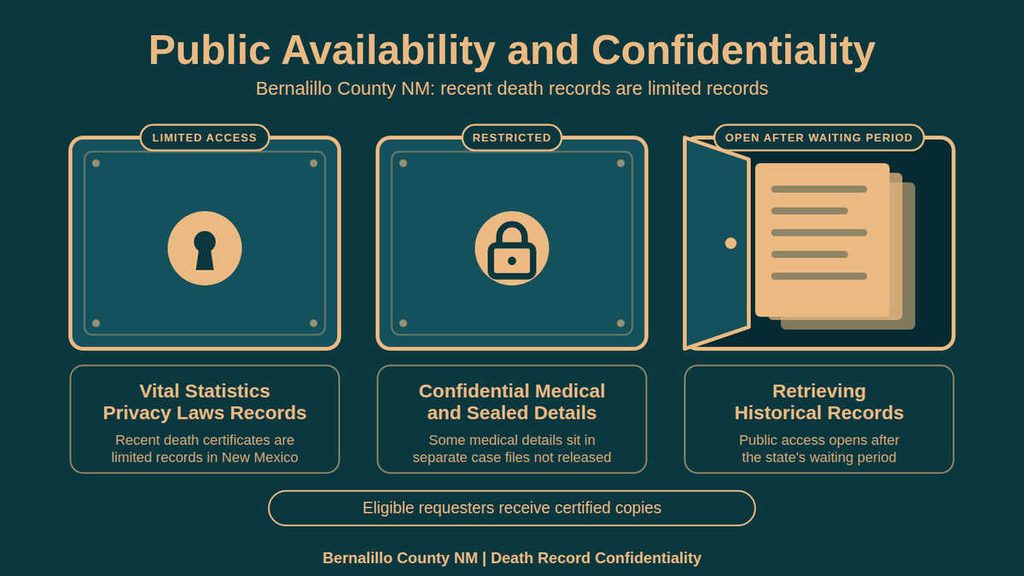
New Mexico treats recent death certificates as limited records. Checking official phone directory provides direct confirmation when evaluating public records. Eligible requesters receive certified copies, and the general public reaches a record once it passes the state’s waiting period. Confidentiality also runs below the certificate level, since some medical details live in separate case files that the bureau does not hold or release.
Vital Statistics Privacy Laws Records
If a death happened in Texas, the Texas rules control it, and the New Mexico bureau cannot produce that certificate. Texas treats a death certificate as confidential for 75 years under its Health and Safety Code, apart from stated exceptions that include certain personal or family uses and requests tied to a family medical history. Requests for a Texas death must go to Texas Vital Statistics, and a New Mexico request for a Texas event will return no result.
The same rule works in reverse. A death that occurred in New Mexico belongs to New Mexico records even when the person lived elsewhere, and a Texas request cannot pull it. When a family moved between states, check each state separately, since two certificates can exist for one person when the death and the residence sat in different states.
Confidential Medical and Sealed Details
Several kinds of records sit outside the death certificate and follow their own release rules. The registrar files the certificate, while the medical examiner, coroner, hospital, police department, and funeral home each keep their own files. Asking the bureau for a death record never produces those documents.
- Autopsy reports and toxicology results, held by the medical examiner or coroner
- Emergency medical services run sheets and hospital records
- Police and investigative reports on some deaths
- Court-ordered sealed records and files held under a protective filing
When a cause of death reads as pending, the medical examiner’s office can explain the case status. Once the review closes, the bureau amends the certificate with the final cause. If a family needs the medical findings for a health history, ask the medical examiner’s office about its own release process, since that request follows a separate path from a death certificate request.
Retrieving Historical Records
The 25-year period is measured from the date of death. Once a record passes that mark, New Mexico accepts public requests without a statement of eligibility, and the record becomes part of the public death index that family historians use. Older entries may exist only as scanned images rather than original filed certificates, and a copy may come as an uncertified record in those cases.
Older certificates may use earlier number formats, so a search by record number alone can miss a match. Search by surname, date of death, and county first, then confirm the record number from the result. For events before 1903, county and local sources often hold the only trace, and a historical society or cemetery register can supply the date and county needed for a later search.
Record Accuracy and Problem Resolution
Most empty search results trace to a short list of causes: a name spelling, the wrong county, a death filed in another state, a certificate still in medical review, or a record that never reached the state file. Work through those causes in order, and you can usually turn an unlisted death record into a located one.
Matching Similar Names
A common-name result is only a candidate until a second fact confirms it. Compare the legal name against any alias on file, then check the date of birth, the date of death, the county, and the age at death. A wrong birth year often separates a parent from a child with the same name, and the county resolves two people who died in the same week.
- Compare the full legal name and any alias shown on the result.
- Check the date of birth, then the date of death, against your own documents.
- Confirm the county where the death occurred, not the county of residence.
- Look at the parents’ names or the informant name for older records.
- If two candidates remain, request both records and compare the details on the certificates.
Verification also protects you from filing the wrong certificate. A certified copy carries the death record number, and any agency receiving it can confirm that number with the bureau. If a copy you received lacks a certification seal or a registrar’s signature, treat it as uncertified and order a replacement.
Delays Across Jurisdictions
A death is registered where it occurred. A New Mexico resident who dies in a hospital in another state has a record filed in that state, and the file may reach New Mexico later through an interstate exchange of records. The same split happens in reverse, which leaves families searching the wrong database for months.
When a New Mexico search comes up empty, request the same record from the state where the death occurred and give that office the date, county, and city. A funeral home can confirm the file number it assigned, the date it sent the certificate to the registrar, and whether the state has acknowledged receipt. If the case involved a medical examiner, ask for the date the cause of death was certified, since that date sets the filing schedule.
Resolving an Unlisted Death Record
An unlisted death record usually needs a broader search followed by a direct request. Start with the surname alone, try spelling variants, and test both the legal name and a married or maiden name. A wide date range with a county filter often reveals a file that a narrow date window removed.
Contact Information
The bureau answers questions about death record searches, request forms, fees, processing times, amendments, and historical records. Contact the office before ordering when your eligibility is unusual, when a filing deadline is close, or when a search returns no result after you have tried the wider search steps.
- Agency: New Mexico Department of Health, Bureau of Vital Records and Health Statistics
- Address: 2554 Camino Entrada, Santa Fe, NM 87505
- Main phone: (833) 796-8773
Have the decedent’s legal name, date of death, county of death, and death record number ready before you call. State the copy type you need, your relationship to the decedent, and the exact purpose of the request, since those details shape both the fee and the processing time. The bureau’s page also holds the current forms, fee schedule, and ordering options for online death records requests.
Frequently Asked Questions
Death records give families and researchers proof of a loved one’s passing, help settle estates, and support vital statistics research. In New Mexico, the Bureau of Vital Records and Health Statistics handles all official death certificates and related documents. Knowing how to locate, request, and verify these records saves time and avoids unnecessary fees.
How can I search for a death record in New Mexico?
Start with the full legal name of the decedent, the exact date of death, and the county where the death occurred. Enter this information on the Bureau’s online portal or call the main line. The system will confirm whether the record is public or restricted, then guide you to the next step for a certified copy or an uncertified version.
What documents are needed to request a death certificate?
You must show a valid photo ID and proof of relationship or legal interest, such as a court order or probate filing. If the decedent died more than 50 years ago, most states treat the record as public, so only a simple request form is required. Include the fee payment method to avoid delays.
Where can I find historical death records by county?
Historical indexes are available at the state archives and many county clerk offices. Some counties also publish digitized PDFs on their websites. For a quick lookup, use the state’s searchable database, entering the county name and a range of years. If the record does not appear, contact the county clerk for a manual search.
How long does it take to receive a certified death certificate?
Standard processing takes 7 to 10 business days after the bureau verifies eligibility and payment. Expedited service, available for an additional fee, reduces the wait to 2 to 3 days. Mail orders may add extra time, so plan ahead if the certificate is needed for legal matters.
Can I correct information on an existing death record?
Yes. Submit a death record amendment form with supporting documents, such as a hospital record or court order, to the Bureau. The agency reviews the evidence and, if approved, issues a corrected certified copy. Expect a 14‑day turnaround for most amendments.